How a misbehaving hexagon taught me more about myself than any tidy pattern ever could…
There are things I know about myself now that I didn’t have language for years ago. One of them is this:
I am not precise.
I struggle to: “measure twice, cut once”. I tried and failed numerous times to “draft a perfect pattern before I touch the fabric”. My brain doesn’t work like that, and as I have mentioned previously when blogging about my sewing antics in FREGUENT FLYERS, KVELLING KVETCHER and ZESTY ZANE, blasts from the past posts where I chatter and natter about me as the sewer/ tailor, and how precise crafting required for sewing takes a lot more of my mental energy…
This is why crochet feels more like home to me: Crochet forgives. Crochet lets me undo without punishment. Crochet lets me fail safely.
If I frog a row, I lose nothing but time, and even that time wasn’t wasted because my hands were moving, my mind was softening, and the rhythm was regulating me. Sewing, for all its benefits for many others, demands a kind of precision that feels fraught and impossible at times… If you rip a seam too energetically, you risk ripping the fabric. Make a wrong cut, and the piece is gone forever, the final product forever marked/ lost/ altered by my impulsive action.
Crochet is fluid. Sewing is fixed.
I am more fluid than I am fixed.
Creating with string instead of cutting fabric
It feels like an achievement to make an object from nothing but a strand. No template. No irreversible cuts. No fear of ruining something precious. Yarn is potential in its purest form, a line that becomes a loop that becomes a structure that becomes a garment.
It’s a transformation in slow motion.
It’s alchemy you can hold.
And that transformation is exactly where I find flow. Where I lose time in meaningful and purposeful engagement, containing the exact perfect balance of challenge and skill application. Fabric starts as something already formed. Yarn becomes.
And somewhere in all of this, I walk that thin, wobbly tightrope between decision‑making fatigue and creative flow. There are days when choosing the next yarn colour feels like an exam question I didn’t revise for: too many options, too much noise, too much pressure to “get it right”. That’s when I reach for self‑patterning yarns (also called ombre, gradient, or cake yarns in the crochet world). I allow the yarn manufacturers to make the decisions for me. These yarns carry their own internal logic, their own colour story I choose to … follow.
Sometimes, though, I find myself wishing and hoping that the yarn will shift to exactly the colour I want in the exact place I want it, a tiny resurfacing of a need for control, a wish to change the decision that had been made for me by the yarn makers I am so grateful for. It’s a forever balancing act: letting the material lead while still feeling like I’m shaping something in a way I want. In neuropsychological terms, it’s a form of cognitive offloading; reducing the number of micro‑choices so my brain can stay in flow instead of spiralling into overwhelm read SAGEPUB.
Crochet brings a balance! Enough structure to feel held. Enough unpredictability to feel alive.
As mentioned before, some of my blog posts have recently disappeared. Whatever disappeared my posts also disappeared my old Wearables page; although some ghost links to the page may still pop up*. Initially, I may have wanted to rebuild it, like I did the posts. But the truth is: I don’t think my blog needs it now. I still make wearables, yet the page’s absence feels… okay. Like pruning a branch so the rest of the tree can breathe.
There’s something freeing about letting a part of your creative identity presentation dissolve without replacing it. Psychologically understood as identity transformation (Ibarra, H. (1999). Provisional Selves: Experimenting with Image and Identity in Professional Adaptation.), sociologically termed role exit (Ebaugh, H. R. F. (1988). Becoming an Ex: The Process of Role Exit.) and occupational therapy’s identity reconstruction HERE and role transition HERE name the same process, similar phenomena from different lenses of looking at it. Whatever you choose to call what has happened, the final pondering is the same:
It’s not loss; it’s space‑making.
And maybe that’s what the missing page is for me: a reminder that I don’t have to document everything, justify everything, or keep every version of my work displayed. And don’t despair, you can still find all the wearables by searching the WEARABLES category in the blog. Win – Win, I feel….
The hexagon that refuses to lie flat: that’s the whole magic
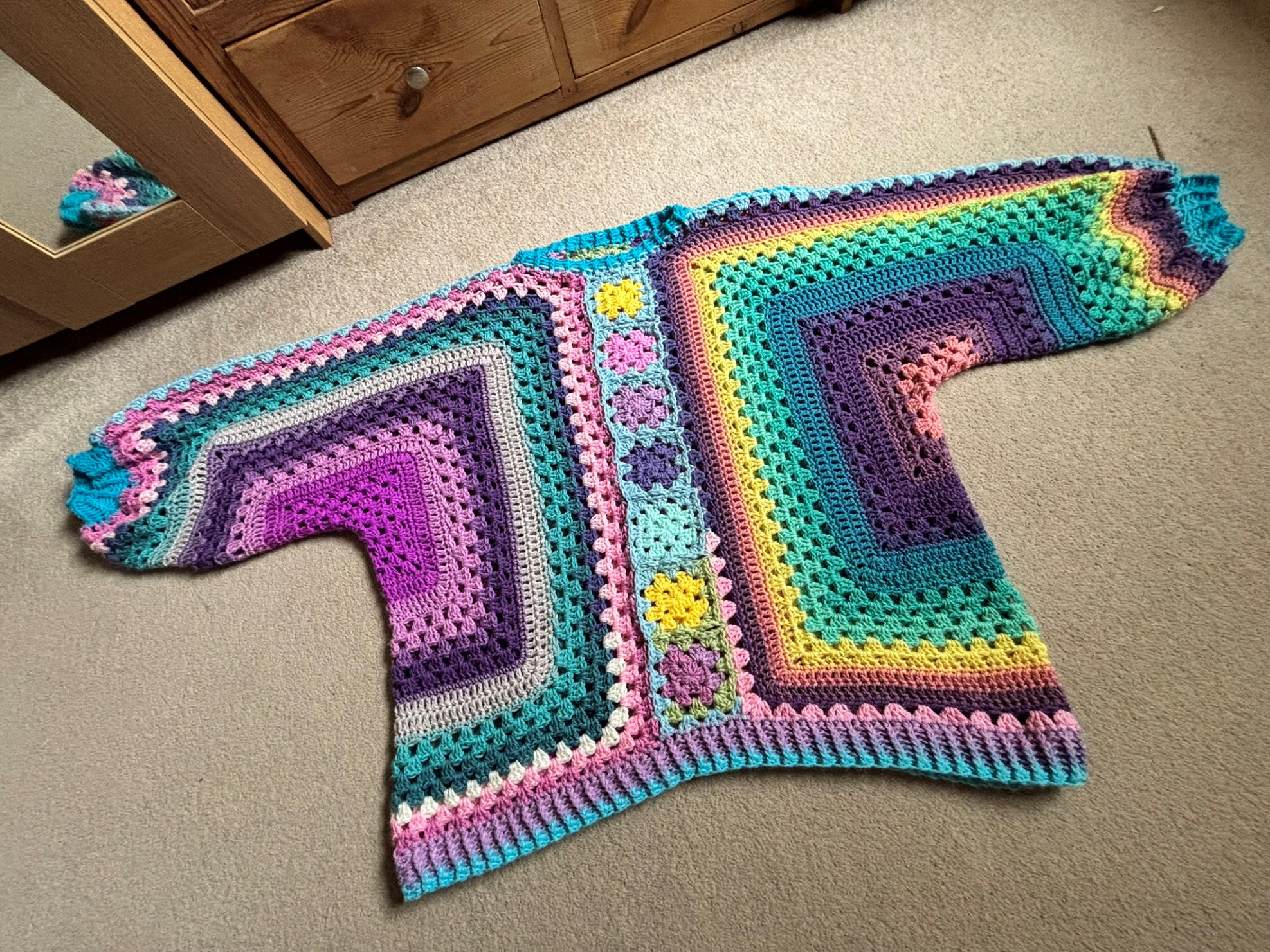
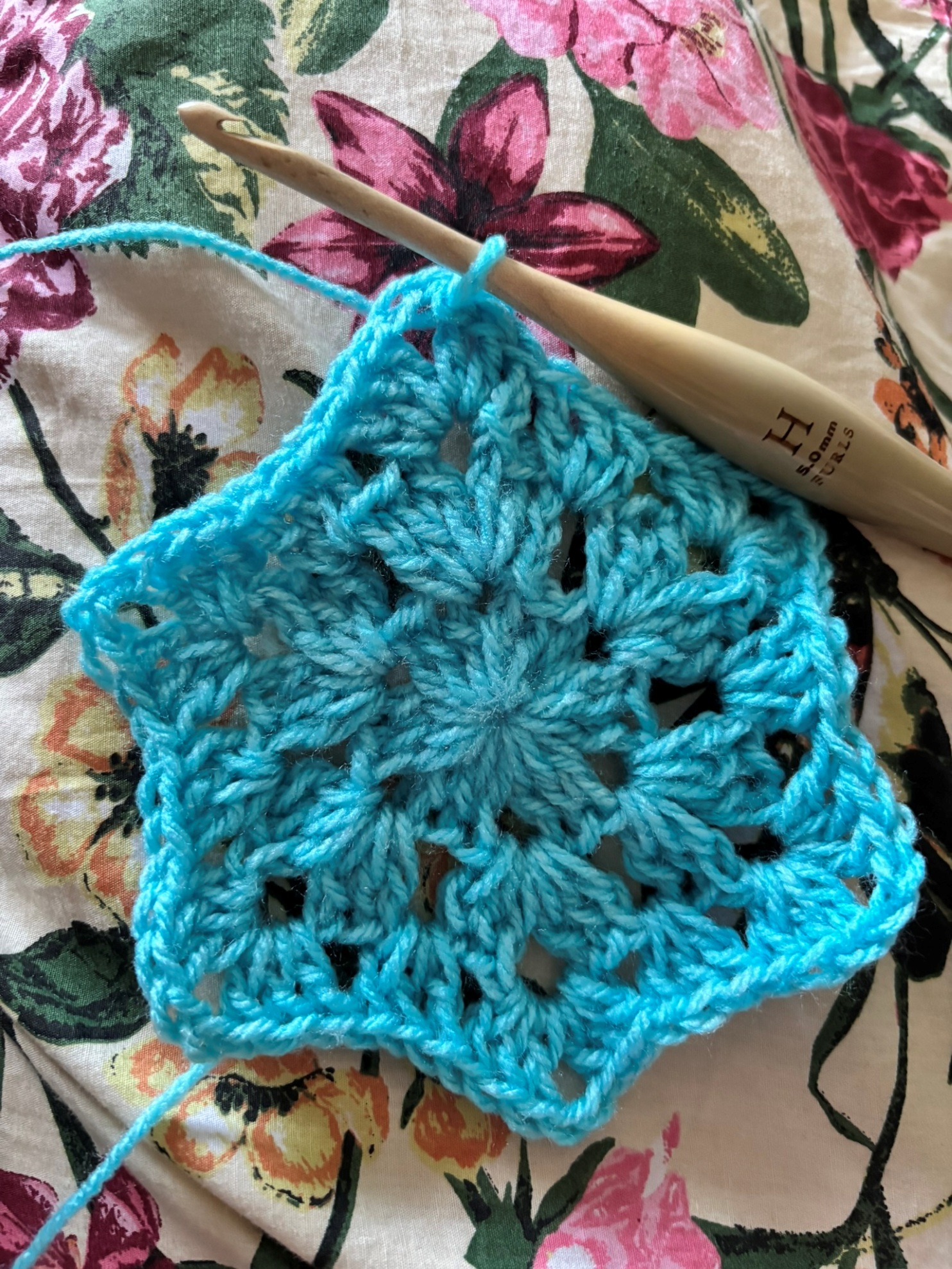
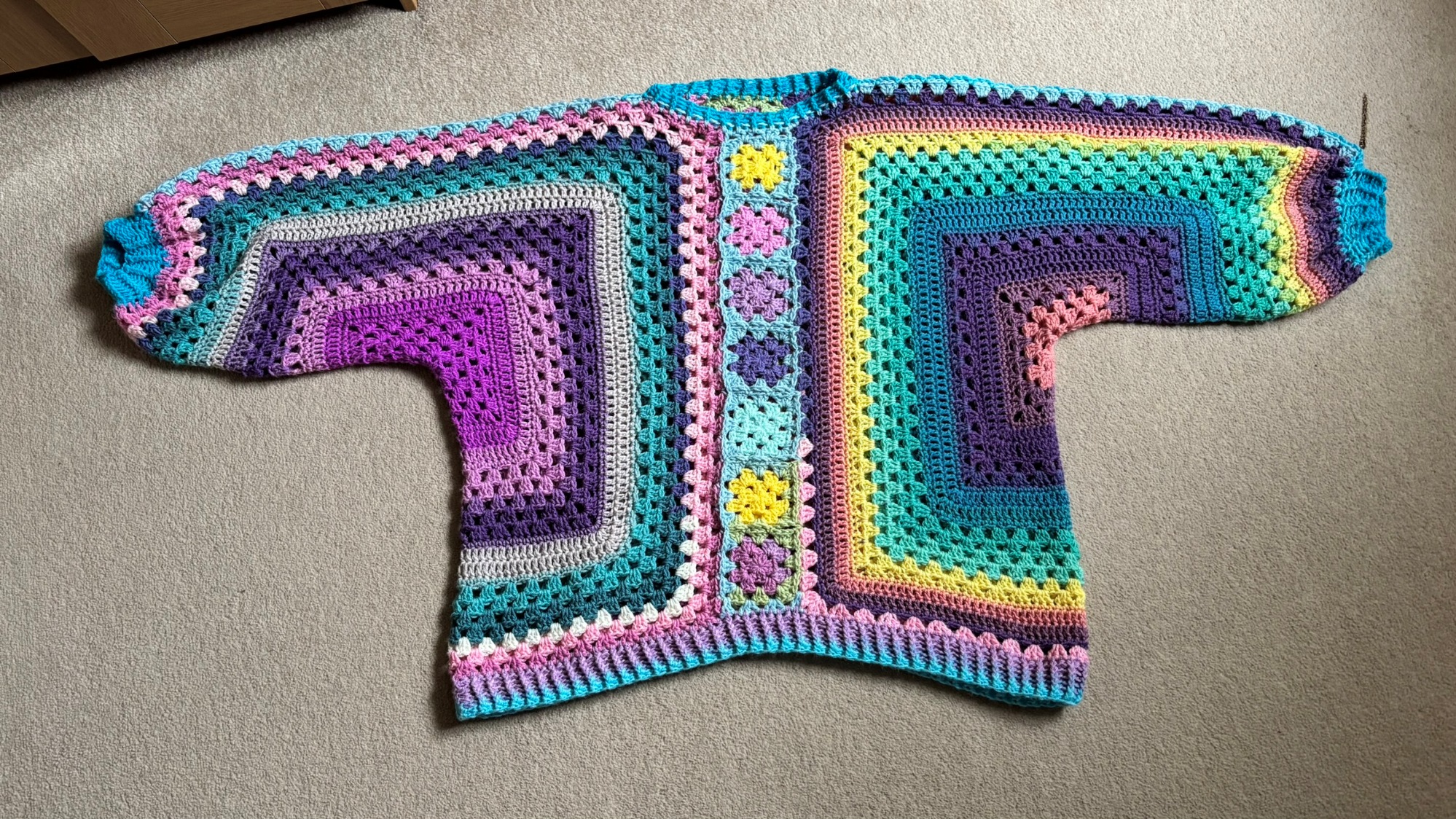
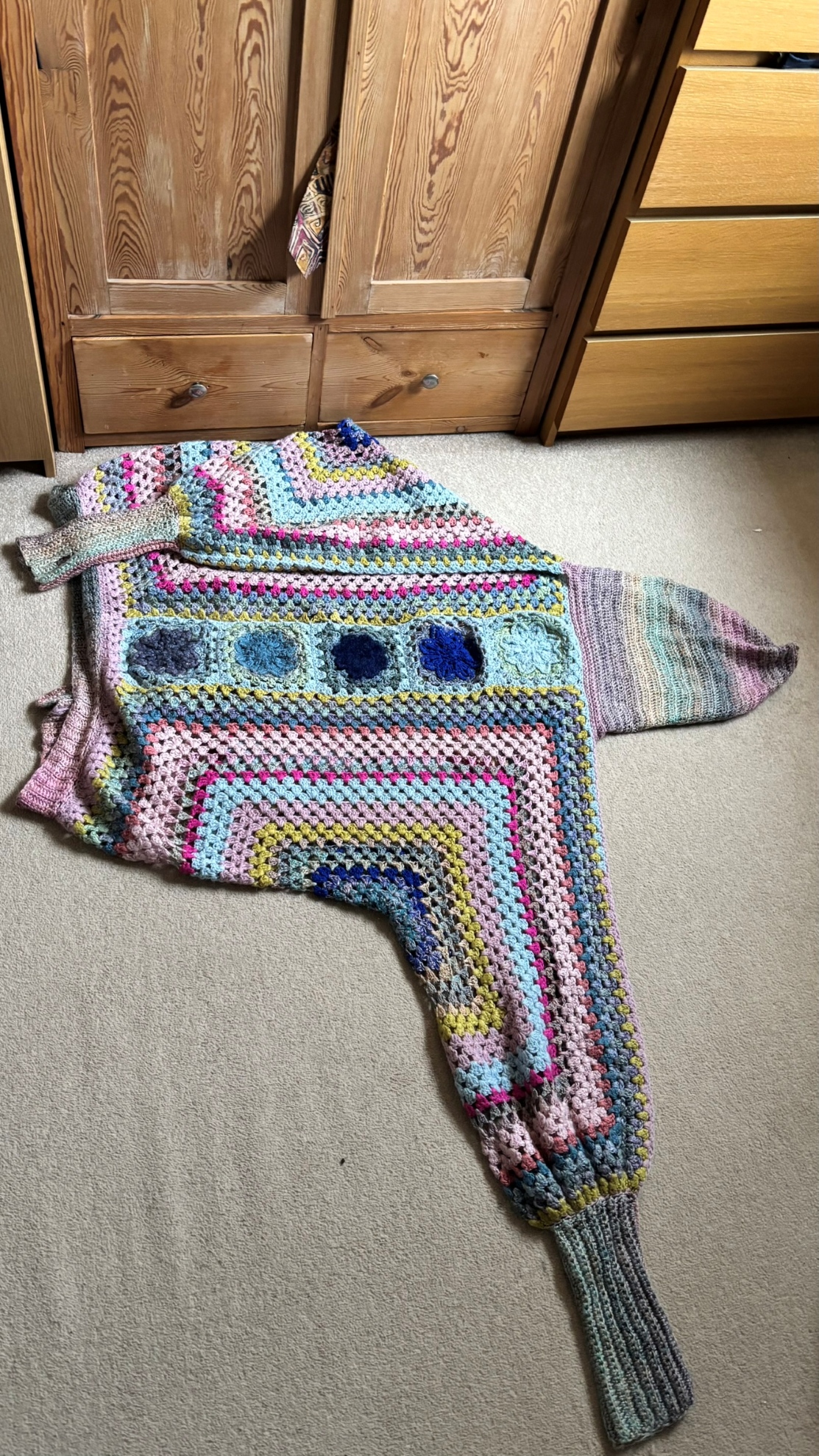
I didn’t stumble into this blindly. I knew the hexagon wouldn’t lie flat; that was the entire point. I made one before. The classic granny‑style hexagon has a long, well‑documented history of misbehaving when worked in the round. Crocheters have known for decades that the corners expand faster than the edges, that the stitch pattern creates built‑in bias, and that the shape naturally cups and folds along invisible diagonal lines. On the original sweater, I got some beautiful handmade glass buttons made to order by a very good friend of mine, Appreciations to TABITHA. You are unable to see them in the photos, as they were added after the images were taken. I will attempt to provide updated pics soon. 🙂
Now it is time for:
Geeky History Corner
I went looking. Why? When? and how did the crochet community discover the magic of the hexagon folded T (L) shape? Crochet as a garment design area emerged in the 1960s and 1970s, as documented in a dissertation thesis: LOOK HERE. I am so very excited to share this! Someone else is using crochet in art and writing about it! YEY!
They used granny squares to build their garments, so this was a step, but not quite the answer I was looking for… Search continued. I then found the earliest recorded use of the hexagon, which you can read about HERE, followed by the first officially published pattern design for it by Lynne Rowe below:
https://knitcrochetcreate.co.uk/2025/11/free-hexagon-cardigan-crochet-pattern
At the time of writing this post, there are ample versions available, tutorials and such like, variations etc, I will list a few, the rest is up to you: RAVELRY chunky version pattern; as well as a double knit yarn version HERE; another pattern version by TheCrochetedPeacock here, as well as finished beautiful jumpers and cardigans sold by CrochetCraftsByAli, (search “hexagonal cardigan” on ETSY for more options). There are posts on social media also, I shall leave you to do your own searches there, marvelling at the simple effectiveness of the workings (read magic) and transformation happening during making one of these beauties:
“Wait… it just folds like that?”
That’s why this construction is so widely used.
Because it feels like magic. AND. Because the hexagon isn’t just a shape; it’s a behaviour!
Stubborn, unruly, doing its own thing regardless of what those making it may have expected… And I love that. I love working with something that has its own logic, its own intentions, its own quiet rebellion against flatness. It aligns well with my “cut first, measure second” approach to creativity.
When counting fails, adapting begins
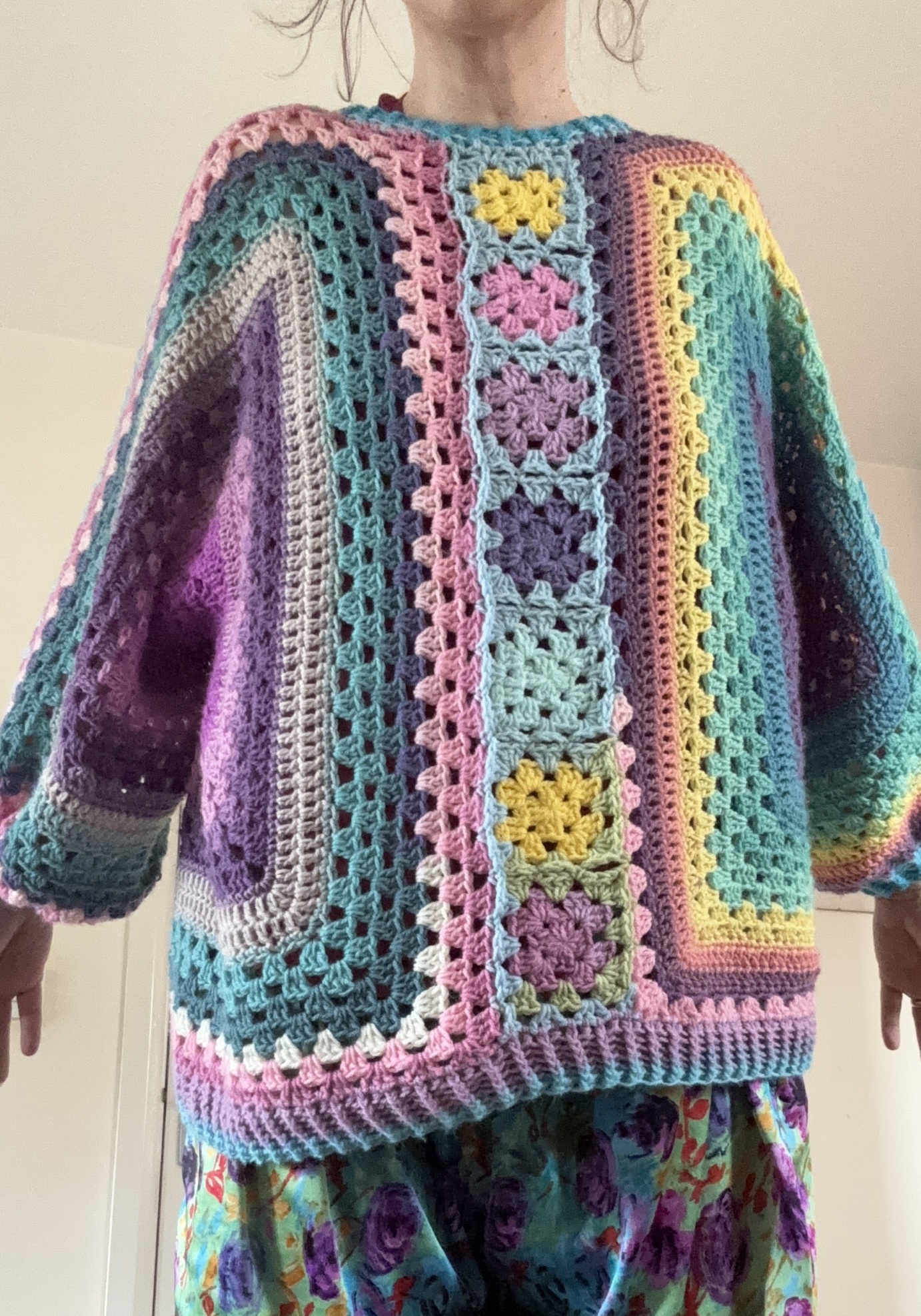
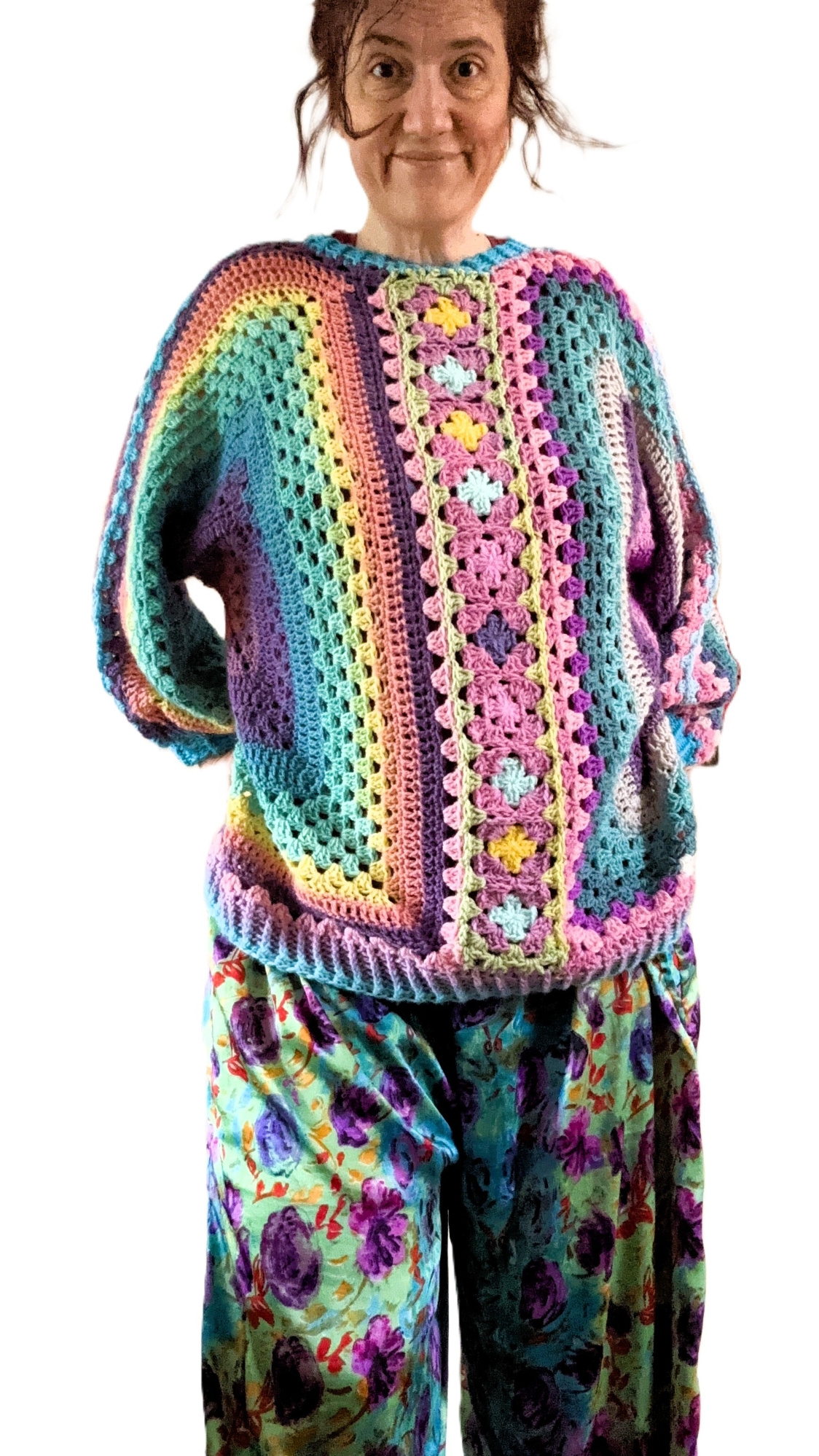
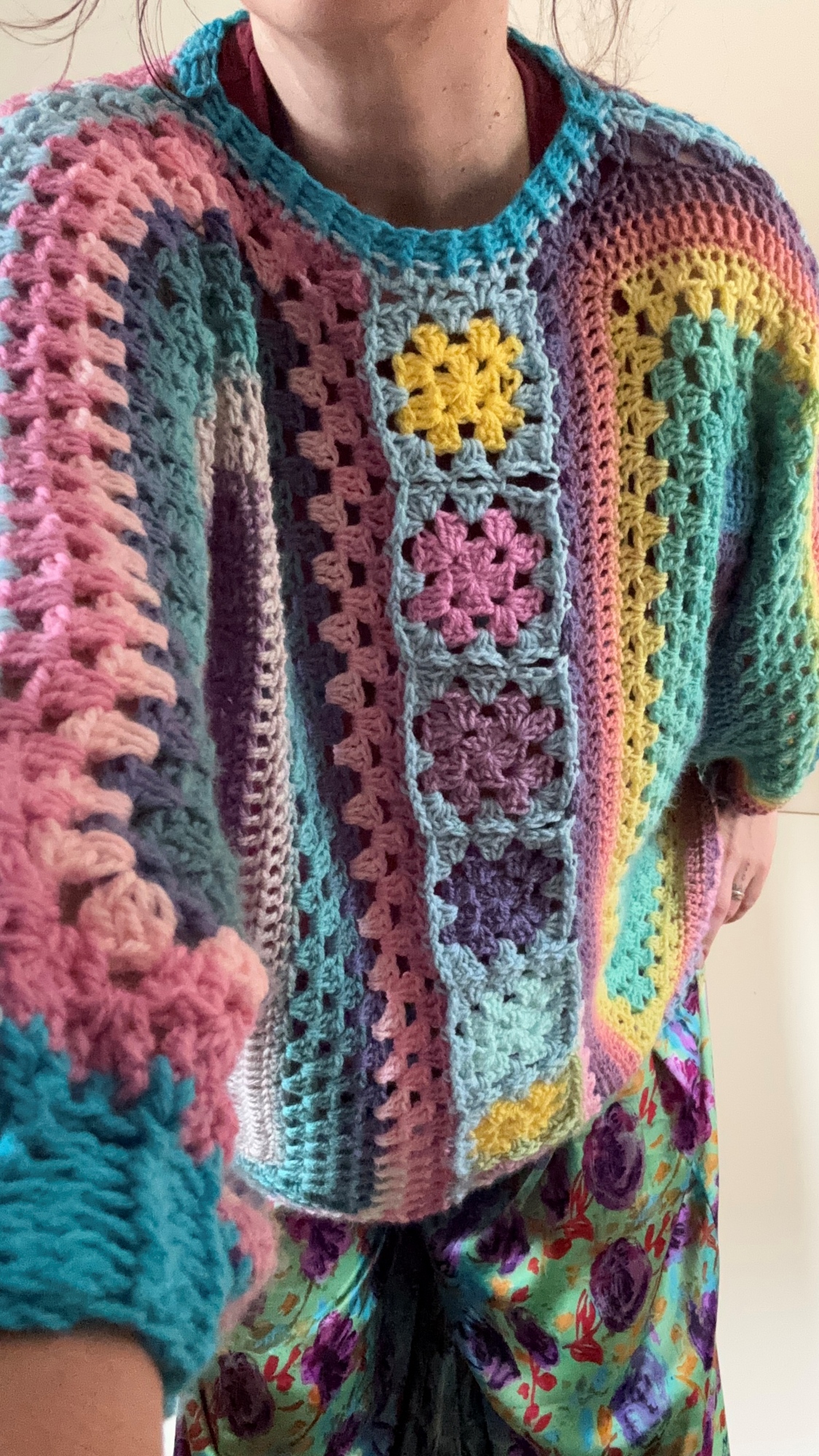
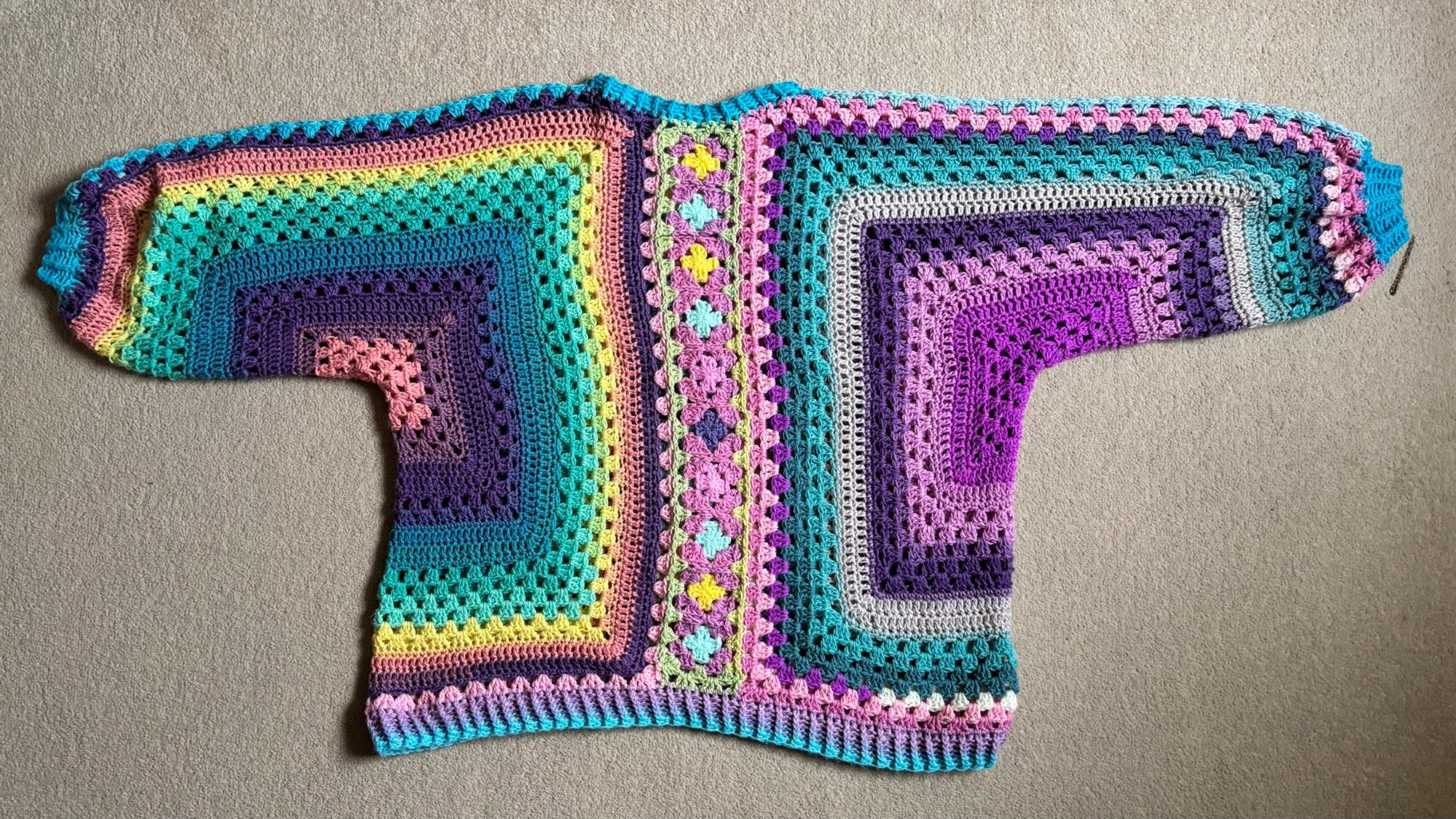
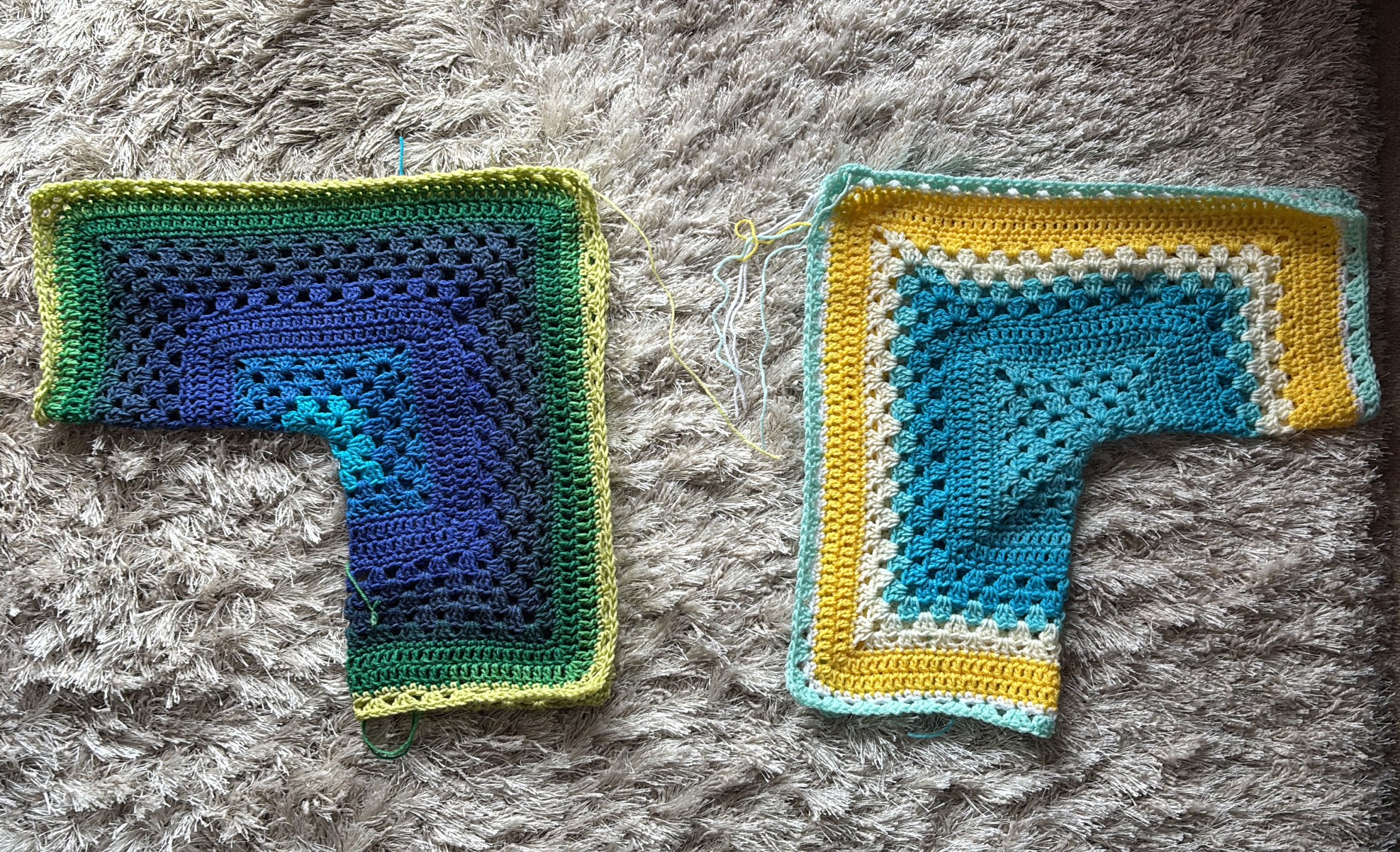
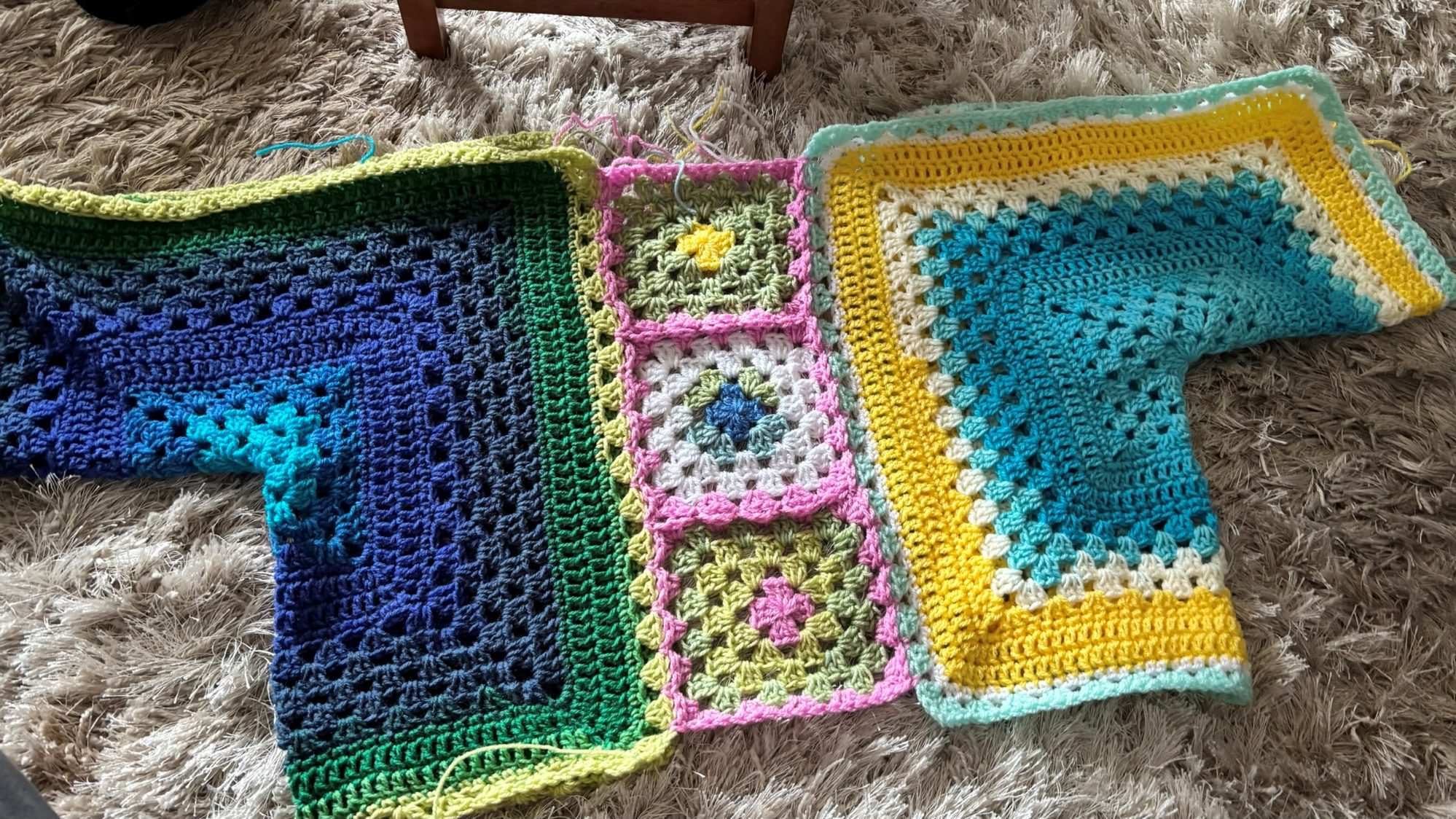
Having a positive experience with the first sweater, although somewhat hugely oversized and therefore hardly worn or suitable for outside activities and layering in the rain, I embarked on making my second garment in this style, enthused all the more by the unexplainable, nigh mysterious way this produces a wearable piece by making only two parts (I know, right?!) and by deciding to use a newly found favourite self-patterning yarn make, MANDALA YARNS by LION brand. I decided this time, it was going to be a pullover.**
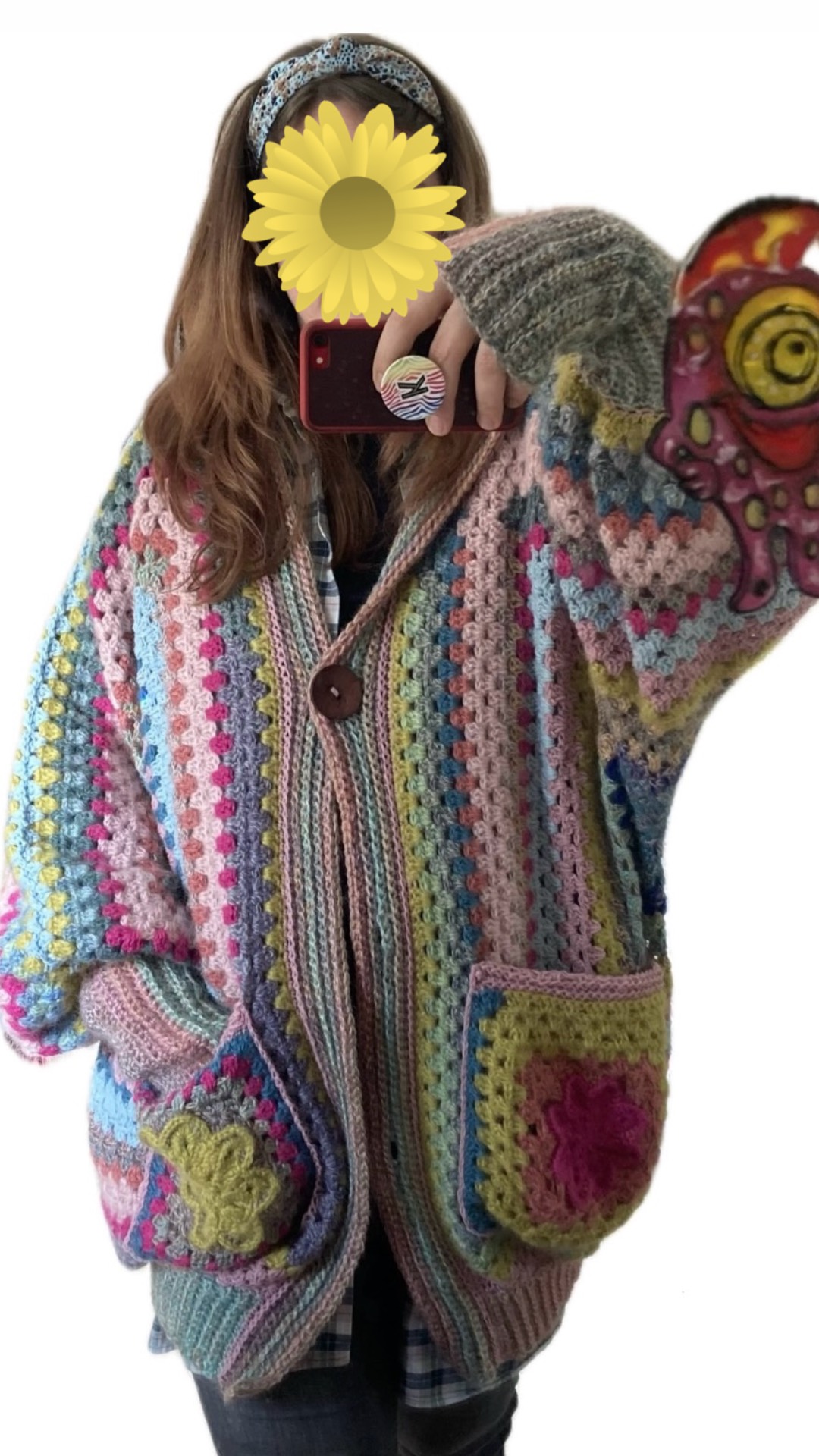
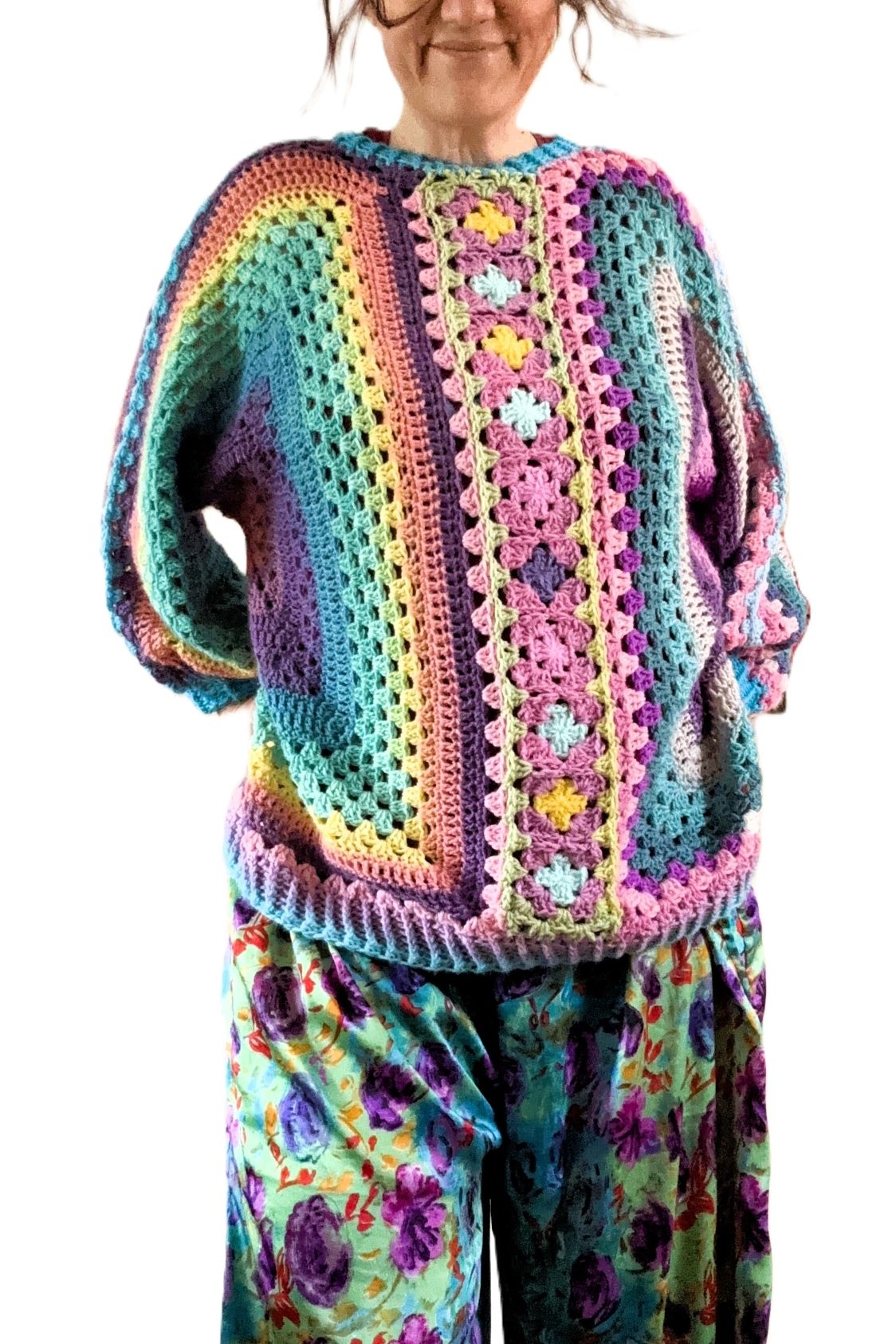
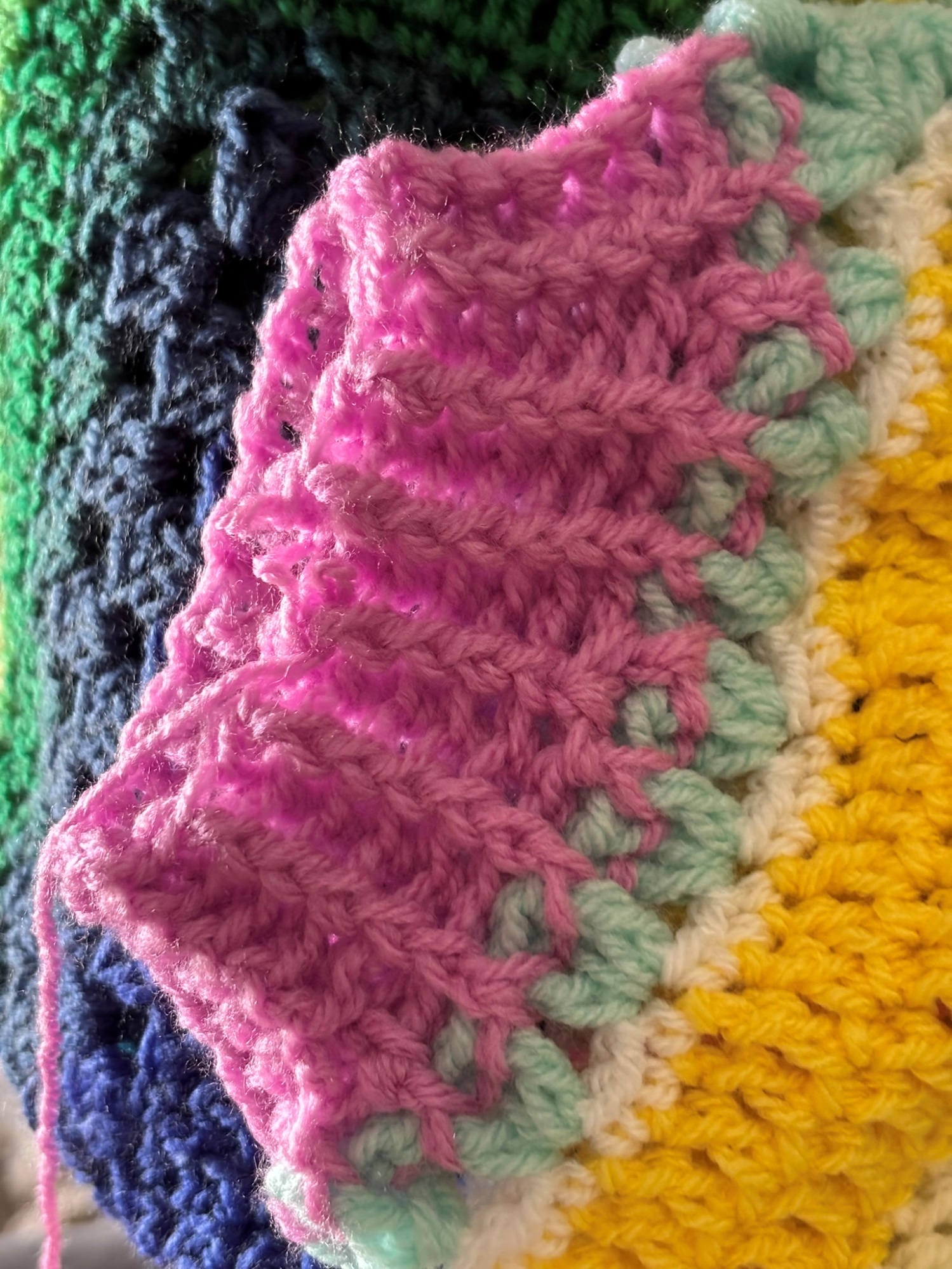
When I finished the first hexagon, I wanted to add little squares to look like “buttons” to connect the two side pieces, on both the front and the back.
I tried it the rigid/ planning way… I tried to count. I tried to plan. I tried to think through the maths of how many squares I would need to make so I would have enough to connect the three treble sets, as I had connected the middle piece to the existing two using a connect-as-you-crochet-along method. It is a big sentence, yes. Big sentence describing a big feat! It went something like this:
- My brain (B) said: B: ‘We have it now, you leave three sets for each mini square, meaning you need 7 altogether.’
Me (M): “Okay, here is seven, shall we connect them? Let’s try to connect this again… Oh, the math is not mathing, we are nowhere near the end of the line, where we needed to be???” - B: ‘Oh I don’t know then, my math was solid! I give up.’
- M: “Don’t give up, we are nearly there…!”
- Body jumps in: “What are you two wobble heads up to? Let’s just trial and error, I feel we are nearly there…”
- M: “Okay, then, let US three try this again!”
There is a formula somewhere, and formulas are not where my creativity lives. I couldn’t get the numbers to line up, so I did what crochet always invites me to do: I adapted. I tried something, checked it, undid it, tried again.
Trial and error without consequence.
A safe way to fail.
A safe way to learn.
And every tiny success, every moment where something finally clicked, felt like a little spark of achievement. A flicker of “oh, I can do this”, which my brain values so very much.
Hexagonal granny square jumpers are a collective fractal flux:
Because they grow the way I grow: round by round, micro-decision by micro-decision. Never quite flat, never quite predictable, always shifting into the shape they need to be.
Because they transform as they expand, from a flat star-adjacent shape to a cupped bowl to a folded T to a wearable garment.
Because they mirror the way my creativity works: not linear, not planned, not precise; adaptive, iterative, forgiving, and alive.
Because they honour the truth that some things can only be figured out by doing, not by thinking.
Because they are a pattern that behaves like a sentient thing. Because it is geometry with a pulse.
Because they are me, if I were a shape! Unpredictable AND predictable in equal measure… 🙂
Thanks for reading my story of how a shape becomes a sleeve, how a mistake becomes a method, how a strand becomes a structure, and how a person becomes more themselves through the act of making.
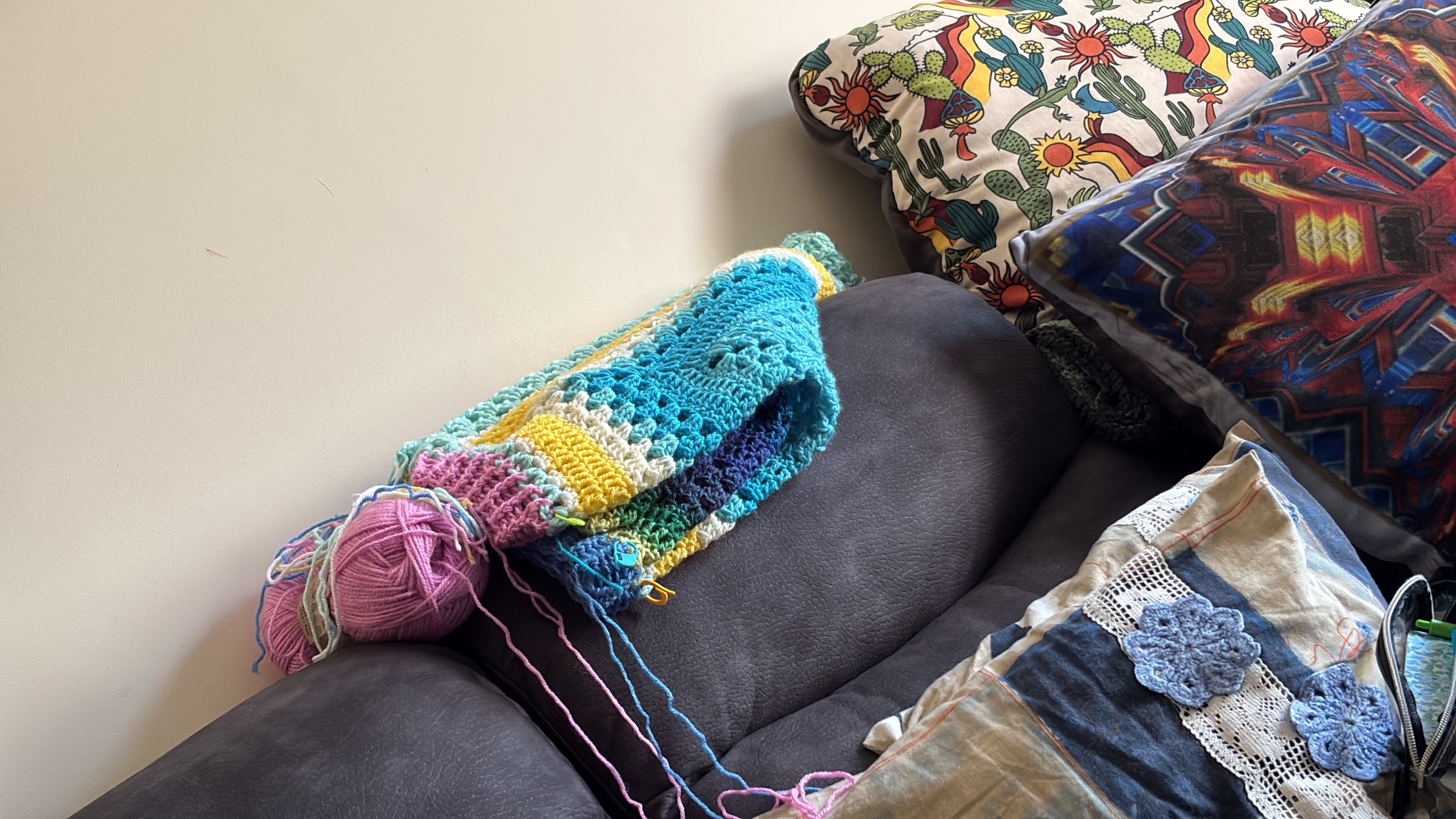
Oh, and BTW: There is a third jumper/ pullover on the hook currently, and I was really, REALLY, REALLY hoping to be able to photograph and present it finished here…. Then patterning did not pattern, and it is now sitting in the corner sulking, as I sit in the opposite corner sulking also, leaving the back brain to figure out how to fix the weirdness that was not quite working well with this woolly wonder.
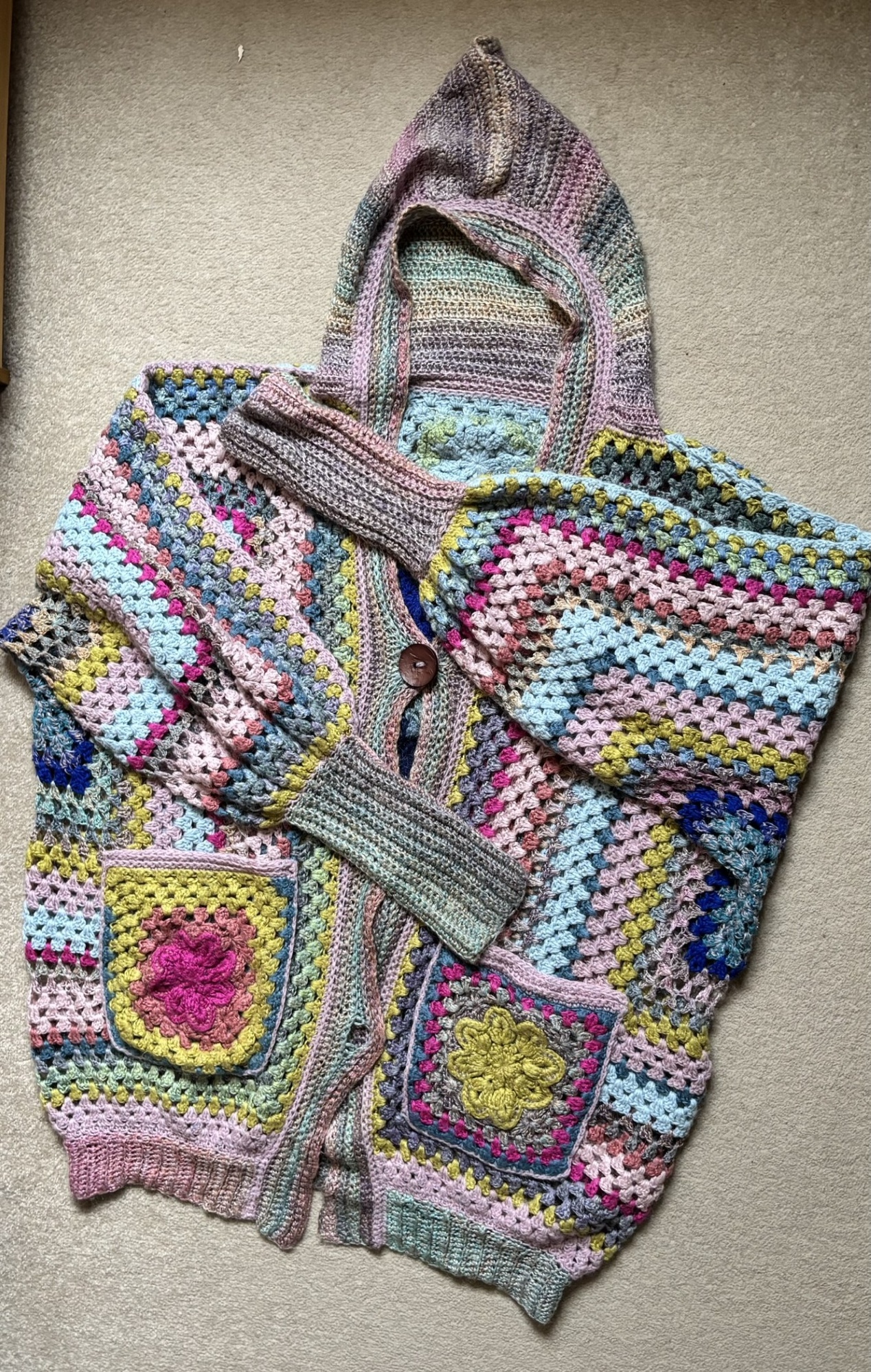
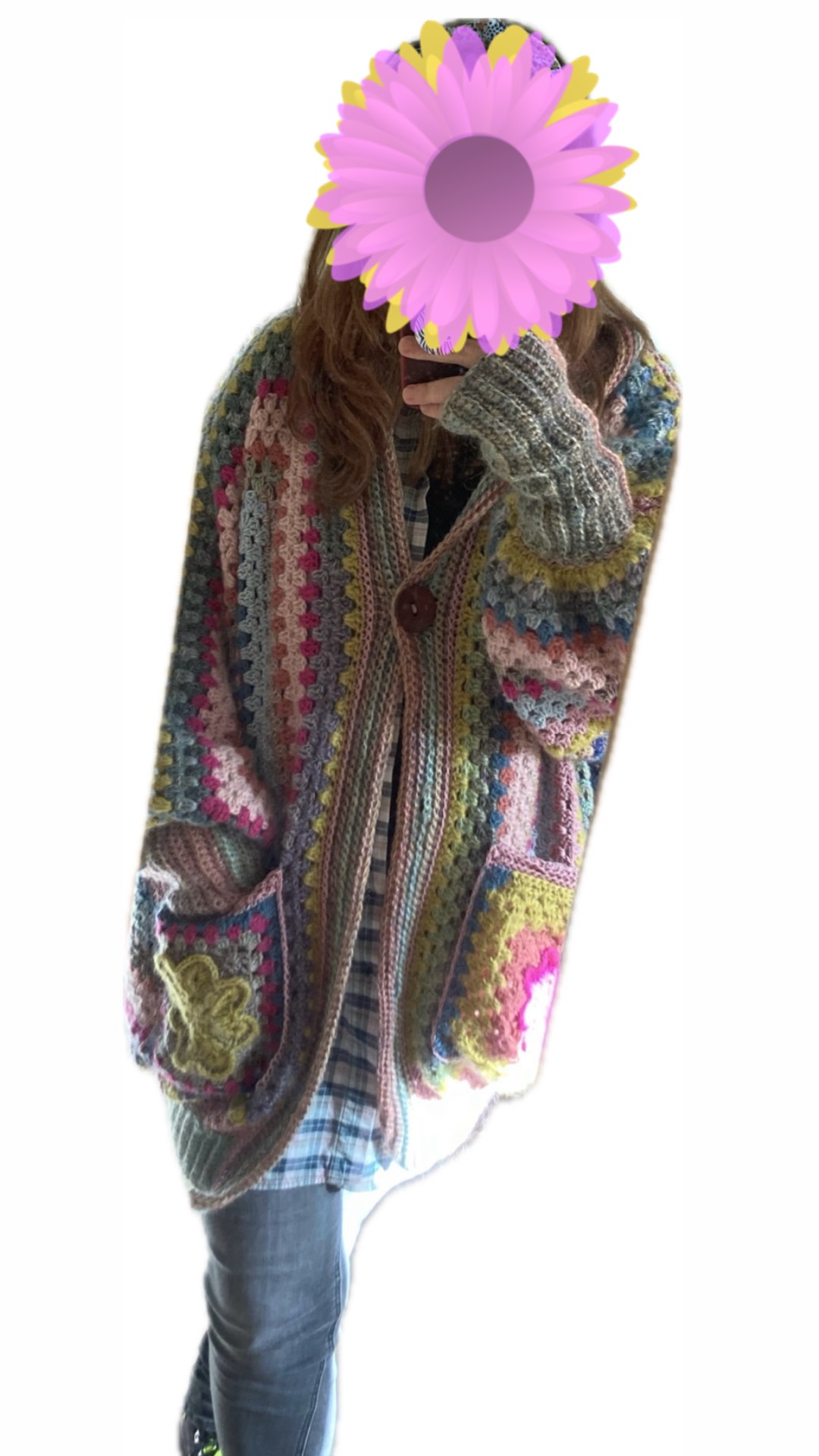
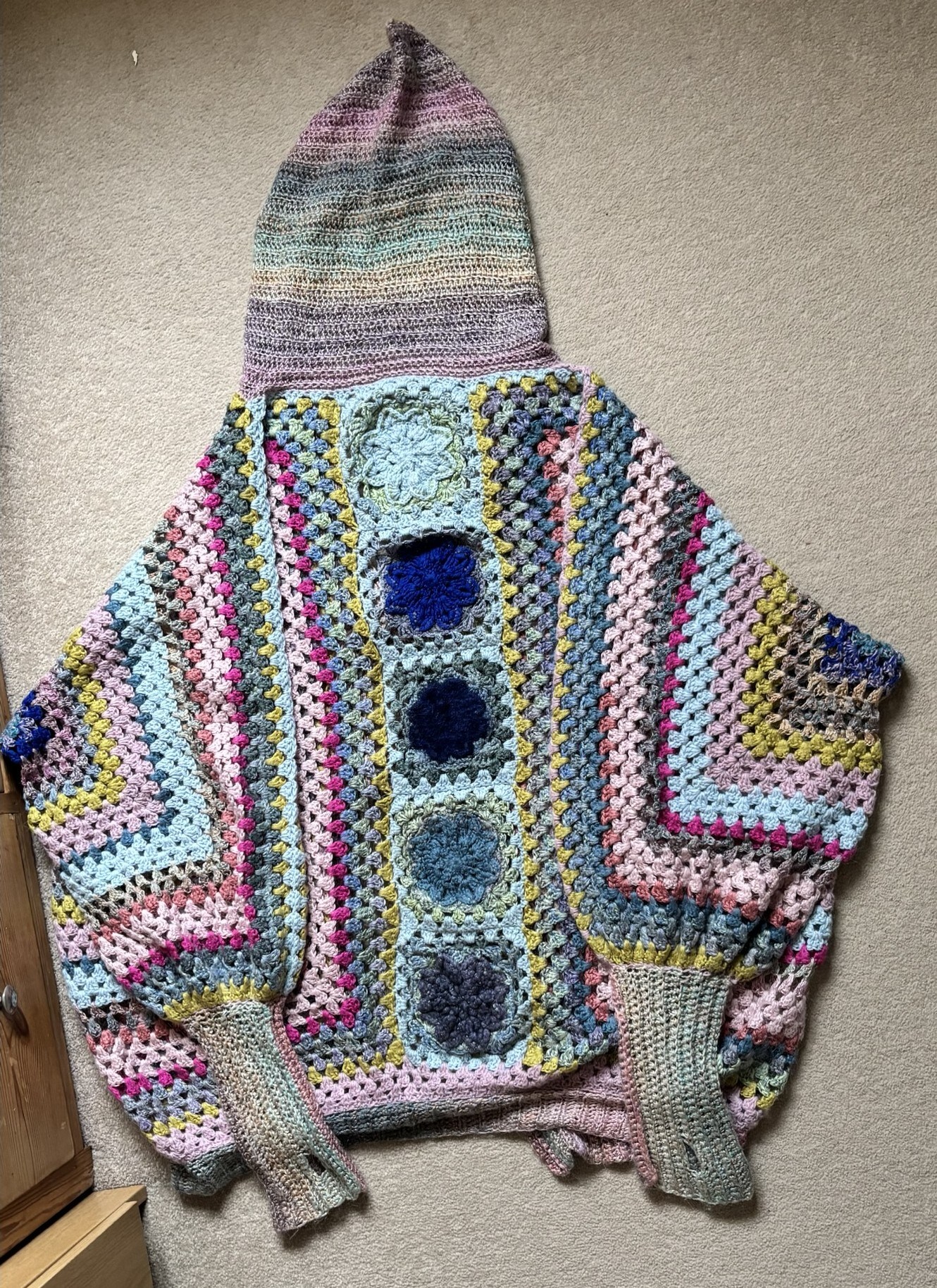
*Please CONTACT me if you find any links that do not function….
**To enhance the sense of mystery, I really am not mysterious, by the by; I will let you search the explanation of the two terms on your own terms…